:: Lee Rourke Homepage ::

""A story assembled from everyday objects, unassumingly and quietly, that stuns and horrifies by increments...The Canal may look, at first glance, like a love story, but it harnesses the power of parable." John Wray, author of Lowboy.

Search This Blog

Showing posts with label Reviews/Criticism Archives. Show all posts

Thursday, 25 February 2010

In Print(10) . . .

Who cares about Ann Quin?

"A man called Berg, who changed his name to Greb, came to a seaside town intending to kill his father . . ."

For me this is the greatest opening first line of any novel I have ever read. It is from Berg by Ann Quin: a debut novel so staggeringly superior to most you'll never forget it - and by one of our greatest ever novelists too. The thing is, though, no one ever seems to have heard of her. It is something that has rankled within me for a long time now: why, I demand to know, does nobody care about Ann Quin?

Quin was born in 1936 in Brighton, one of our more interesting seaside towns (she died there too in 1973: swimming out to sea one morning by Brighton Pier never to return to our shores again). Four books were published in her lifetime: Berg (1964), Three (1966), Passages (1969), and finally Tripticks (1972). Berg is her most famous (and possibly my favourite). It is a paean to the Nouveau Roman of writers like Alain Robbe-Grillet, eschewing the literary trends of her day: those angry, realist campus yawns that put the British working-class voice on the literary map. Ann Quin's was a new British working-class voice that had not been heard before: it was artistic, modern, and - dare I say it - ultimately European. It looked beyond the constructs of our society. It was fresh, alarming, and idiosyncratic. It wasn't static; it moved with the times.

It was Calder Books who first published Quin, immediately grouping her with Beckett, Sarraute, Duras, Pinget, Burroughs, Trocchi et al. It won her two fellowships, including the DH Lawrence fellowship, which took her to the US for a year. It's hard to believe now how avant-garde these Calder Books writers were, so engrained are most of them now in literary culture and history today. Ann Quin was up there with them then - just as she should be today.

Which begs the question: why is Ann Quin not published here in the UK? Why is she barely read over here anymore? Why did it take Dalkey Archive Press in Illinois, USA to bring her back to us? Where is the literary biography of Ann Quin? What is it about her we just don't get? BS Johnson, for example, doesn't suffer this contemporary obscurity (interesting to note both writers were of the same epoch; similar in literary and experimental outlook; both choosing to end it all in the same year)? Is it a gender thing?

The news, to be fair, isn't all that bad. Writers such as Kathy Acker and Stewart Home have openly referenced/alluded to Ann Quin in their own work, and if you take time to surf the myriad literary blogs and sites, such as Mark Thwaite's RSB, you'll begin to see that Ann Quin crops up time and time again. But is anyone actually reading her?

Berg is a beautiful novel: it is dark, esoteric, haunting - sometimes disturbing. It is saturated with detail, particulars and minutiae. A novel of voices and voice. The best novel ever set in Brighton in my opinion - forget Patrick Hamilton (as splendid as he is), Ann Quin's Berg is the real deal. It cuts through the superfluous like acid and marvels in the seamier mystery all our seaside towns, and especially Brighton, keep hidden. For an insight into what British literary fiction could have been if we'd only have listened, I'd start with Berg by Ann Quin every time.

[original source: The Guardian, Tuesday 8 May 2007]

*

Thursday, 11 February 2010

In Print(8) . . .

Running Away, By Jean-Philippe Toussaint (translated Matthew B Smith)

Jean-Philippe Toussaint, a recent Prix Decembre recipient in France, has carved out a niche in pared down, slapstick literary fiction, within which a serious philosophical undertone lurks. In Running Away – the second in Toussaint's "Maria" series to be translated into English – much of the humour has been discarded to reveal a dark novel about relationships, distance and misunderstandings. Running Away begins with an unnamed narrator travelling to China for a mix of business and pleasure, a "sort of mission" or a "pleasure junket". The narrative hangs on an errand he has to run for his girlfriend, Maria.


The errand is something to do with $25,000 in cash and a man called Zhang Xiangzhi in Shanghai. Zhang is a business associate of Maria's, although it is not revealed why, or how. At an exhibition the narrator meets a Chinese woman, Li Qi, and agrees to travel to Beijing with her. A strange ménage à trois is completed when Zhang offers to travel with them. It soon becomes apparent that Zhang and Li Qi are acquaintances, either lovers or business partners (he isn't quite sure).

A novel of dizzying movement ensues. Ostensibly set in the summer, much of this takes place at night, where everyone seems to be in a state of "perpetual jetlag". Characters are constantly travelling from one person and place to another, or just about to set off to yet another destination. There is a constant blurring of perspective and reality is always shifting as if through the lens of a rotating prism.

There is only one real moment of clarity and stasis, on the night train to Beijing, where the narrator and Li Qi lock themselves in the cramped confines of a bathroom and kiss passionately. It is at this precise moment the narrator receives a call from Maria announcing the death of her father and again, only this time with a dramatic weight, the narrative slides further into an alternate dimension with the voice on the phone, "thousands of kilometres away... despite the expanse of night". Again, things move on.

The narrator cuts the trip short to travel to Elba for her father's funeral (which he doesn't attend). He begins to feel terrible guilt, believing himself the "person responsible for her suffering". This is Toussaint's darkest novel yet, one in which everything seems to be heading towards the blackest night imaginable. Yet even this looming presence of death is made to feel somehow exhilarating. It is further testament to Toussaint's standing as a master craftsman of the contemporary novel that he can give such shifting insouciance its weight.

[original source: The Independent, Friday, 4 December 2009]

*

Tuesday, 9 February 2010

In Print(7) . . .

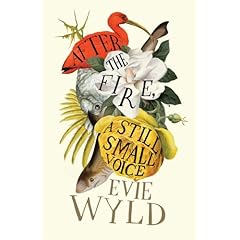
After The Fire, A Still Small Voice, By Evie Wyld

As in all catastrophe, war creates its own aftermath. It leaves in its wake all manner of human detritus – physical or emotional – alone to cope with its horrors in silence. Evie Wyld's debut novel attempts to decipher the trauma of war. Unfolding in eastern Australia, within an unrelenting landscape, After the Fire, A Still Small Voice tells the stories of fathers and sons learning to cope with the realities of wars they do not understand.

Following a miserable relationship, Frank moves to his grandparents' old shack by the sea. He tries to fit in with the local community, living off the land, drinking heavily and trying to make sense of his shattered life. Leon, the son of European immigrants, witnesses the breakdown of his family after his father returns from the Korean war a changed man, before finding himself conscripted as a machine-gunner in Vietnam – leaving him with no other alternative but to escape.

Landscape plays a major role in Wyld's writing. It opens up the narrative, creating an eerie metaphorical space, or silence, between each character, mirroring the physical and mental fissures that separate each generation. Although nothing is truly silent: even the landscape is "thick with insect noise". The power of this mesmerising novel hangs on the premise that silence is impossible, while such impossibility forces the men who litter its landscape to desire it all the more.

Frank seeks a silence his father and grandfather could never attain. Leon, like his own father, is seeking the same but, like the echo of a machine-gun, each reverberation hangs too heavily to ignore. Both are suspended in a present that doesn't belong to them. Within this space there is nothing to do other than look back at the catastrophes that have shaped their lives.

Wyld's writing is assured enough to elongate metaphor and symbolism, creating a novel both taut and otherworldly. This adroit examination of loss, lostness and trauma is the beginning of great things.

[original source: The Independent, Wednesday, 23 September 2009]

*

Monday, 1 February 2010

In Print(6) . . .

Noir, by Olivier Pauvert

Noir, Olivier Pauvert’s debut novel, is an examination of crippling paranoia within a future France, governed by a democratically elected fascist National Party and where a daylight curfew forces nonwhites to live in near seclusion. It is a cheerless vision, explored with great vim, that grows brutal at an alarming rate.

The dystopian thriller is narrated by an unnamed white man, who discovers the mutilated body of a young woman hanging from a tree. He is arrested for the crime and thrown into the back of a police van, but en route to a location out of town, the van crashes and the narrator finds himself the sole survivor. Panic-stricken, he wanders the streets of Paris trying to piece together what happened, soon realizing, with a “piercing sense of déjà vu,” that he has been transported twelve years into the future. The novel then follows a trajectory of malevolent discovery: The narrator has no reflection, his body has morphed into that of another person, and he can kill others with his maniacal stare. He is neither dead nor alive, a “Bastard With No Name, neither chosen nor condemned, an In-Between, a remanence,” hiding from a government that has devised a method of collective mind control. Only the Noir, a disparate group of nonwhites who fight “not to change anything but just to avoid disappearing altogether,” can help him.

As is often the case with thrillers, however, plausible endings are hard to come by, and Pauvert fails to reclaim Noir from the genre’s well-worn tropes. At times, his interest in fostering a sense of macabre violence overwhelms the book’s examination of fascism and its exploration of a nocturnal underworld, inhabited by shady characters who flit into and out of the narrative only when required. Pauvert’s writing is the novel’s saving grace. The latter half of the book, set in alpine landscapes and small towns, can be sublime. Elsewhere, the author’s language, punched up by Adriana Hunter’s translation, is cerebral and quite original: The pacified society gives off “a whiff of disinfected brains,” screeching police-van tires sound like “children being flayed alive,” and the weather of Paris is “the colour of pigeons and pavements.”

A timely sociopolitical edge lends the narrative cultural weight. Noir is an affront to the traditional ideals that have been adopted by President Sarkozy, debunking the premise behind his Ministry of Immigration and National Identity. The novel posits a future of extreme racial control and discrimination, while implicitly attacking the people who voted for Sarkozy—those who were mollified, as is the narrator, by a seductive rhetoric of change. Nevertheless, the reliance on heavy-handed genre conventions undermines the power of these parallels; like George Orwell’s 1984 —to which Pauvert’s novel has quite rightly been compared—Noir is guilty of moments of clunky, plot-driven excess. It is shocking and occasionally brilliant but would have benefited from a steadier pace.

[original source: Bookforum, January 2009]

*

In Print(5) . . .

Dazed & Aroused, By Gavin James Bower

There exists within Gavin James Bower's canny novel an all-knowing shallowness that in lesser debuts would seem flawed. But to ignore, or worse still debunk, such wanton shallowness would miss the point of this critique of consumer society, especially one caught in the far-reaching web of the fashion world.

Following an already-jaded male model, Alex, on his rise to fame, we are allowed a flashing peek into a world most people only see within the covers of a glossy magazine. It comes as no surprise that life behind the super-hyped patina of the fashion industry is just as dismal as in any other substratum of society that demands the real from the unreal. Modelling, like most things trading in ephemeral charm, isn't all it's cracked up to be, especially if, like Alex, one is painfully aware of the facade.

Bower makes all this brilliantly clear in adroit, humorous flashes of insight, revealing a maddening world of myopia and sheer vanity. When Alex introduces his flatmate and fellow model, Andreas, we are instantly informed that he "is with Creative Model Management (like me), has medium to long blond hair and blue eyes (like me), and is tall and slim with a well-defined body (like me)". Alex, saving the novel from the same narcissistic affectation that permeates the whole fashion industry, adds: "I assume the agency put us together because they thought we'd have things in common."

Alex ums and ahs his way through a miasma of castings, photo-shoots, parties, women, men and pills, each as unsatisfactory as the next. In a world of ephemera, where everything has its price, there needs to be something solid to cling on to – and Nathalie, Alex's on/off girlfriend since university, is his foothold in life. But even Alex cannot control this centrifuge and things soon fall apart. Dazed & Aroused is an insightful debut from a novelist who already shows an ability to cut through the hype and reveal the dark heart of everyday life.

[original source: The Independent, Monday, 3 August 2009]

*

Tuesday, 26 January 2010

In Print(4) . . .

Caught by the River, Jeff Barrett, Robin Turner and Andrew Walsh (editors)

In Caught by the River, writers, musicians, environmentalists, anglers and poets contribute to a tranquil collection of accounts of time spent with a favourite river. "Rivers run through men," begins John Berry's "The River Alness", "as surely as they run through the landscape". The temptations of consumerism make it easy to forget the wonders around us. The river cuts through countryside and cities alike, gathering at its own pace towards the sea, offering solitude and respite.

Such is the strength of the emotional spell a river can cast, it comes as no surprise that the majority of the writing here concerns itself with the past. Passing generations are marginalised by gentrification and childhood adventures (with the obligatory father-and-son "bonding" yarn) take place in an idyll long disappeared. Such passing of time is evident in Robyn Turner's assured "Endless Summer" and Matthew De Abaitua's lament on the demise of the Liverpool docker, where "the engineering of man and nature" once complemented each other.

Childhood friendships are galvanised by an unsuccessful fishing trip for chub by the Wear in Ben Myers' exploration of place, "The Dirt Waterfall". But it's not all about the architecture of memory. Jarvis Cocker's "South Yorkshire re-creation of Apocalypse Now" is genuinely amusing, even when his River Porter voyage, "Acrylic Afternoons", becomes a metaphor for life.

There is much to glean from this collection, especially in the writing that eschews sentimentality and delivers a psychogeographical odyssey. Sue Clifford and Angela King's "The Language of Rivers" is a treat, as are the ever-knowledgeable Bill Drummond, Peter Kirby and Jon Savage.

The editors have shepherded a spirited and diverse collection of nature writing. Caught by the River taps into a growing unease with a present which is felt to be leaving us behind, and where the idyllic past we crave seems further from our grasp each passing day.

[original source: The Independent, Wednesday, 1 July 2009]

*

Friday, 22 January 2010

In Print(3) . . .


The Power of Flies, By Lydie Salvayre (trans. Jane Kuntz)

Blaise Pascal—the 17th-century mathematician and philosopher centrifugal to Lydie Salvayre’s The Power of Flies—underwent, in the latter half of his life, some kind of personal metamorphosis: he morphed, quite publicly, from a man of scientific methodology and knowledge to a deeply religious philosopher committed to the Augustinian idea that man’s descent had putrefied human spirituality to the core. He then, in a paradoxical somersault of quite gargantuan proportions, it would seem, spent the rest of his life writing an apologia for the new belief system he had so deeply adopted: Christianity. These later writings were never completed, and after Pascal’s death they were published collectively to form what later became known as his Pensées.

It is in these Pensées that Lydie Salvayre’s main character—a nameless museum guide at Port-Royal-des-Champs awaiting trial for his father’s murder—finds his philosophical solace and manages to espouse his own rage in a way that gives him a “foothold in the void.” Port-Royal-des-Champs is the abbey that in the 17th century offered a home to a variety of Jansenists, and most notably Blaise Pascal. Not only are the Pensées the narrator’s obsession, they are also the novel’s—and ultimately Lydie Salvayre’s.

Lydie Salvayre is a novelist of philosophical and theoretical ideas realized through voice, and not plot or characterization. This is not to say that her nameless museum guide is not a believable character—he wholly is—it is to emphasize that Salvayre’s own ontological progression throughout the work is far more important, especially to readers who want their literature to ask them questions and to ultimately engage with the text. When reading The Power of Flies we are witnessing a work that intelligently eschews the flabby trappings of the modern, commercial novel.

Born in France to Spanish Republican Communist/Anarchist refugees, Salvayre is a writer that creates novels at once unconventional and delightfully marginal, suspended on the peripheral vantage points of the social order. Her first novel La Déclaration (The Declaration, 1990) was written in her mid forties. Early in life Salvayre abandoned her literary studies to pursue a career in psychiatry—which she still practices in Seine-Saint Denis—and its influence on her work is undeniable. Nearly two decades on from her literary debut Salvayre has produced some startling works: La Vie commune (Ordinary Life, 1991), La Compagnie des spectres (The Company of Ghosts, 1997), Quelques conseils utiles aux élèves huissiers (Some Useful Advice for Apprentice Process-Servers, 1997), La Conférence de Cintegabelle (The Cintegabelle Lecture, 1999), among others. It is an idiosyncratic oeuvre that is at once distinguishable by the spoken communications embedded within: lone voices that are indefatigable in fervor, serving as verbal conduits that deliver to us the myriad intrinsic desires of the individual. Many of these voices zero in on the social and personal intersections of violence that society, upbringing, and parenthood help to create.

Elsewhere(1) I have incorrectly described Lydie Salvayre’s writing as a series of soliloquies—they’re not. There is a slight difference: A soliloquy traditionally serves as a work’s defining moment,(2) when things become clear, bringing things to a logical closure, whereas the nameless narrator’s monologue in The Power of Flies merely rants; it offers no conclusions other than to lend an insight into his blackened heart. Salvayre’s entire narrative can be seen as an orchestrated othering of words; a form of dislocation; a dismemberment of voice. Or, as Stefanie Sobelle quite rightly states, “A peculiar kind of exterior monologue, wherein the speaker employs an unnaturally elevated language.”(3)
And truly it is an unnaturally elevated language:

“Make a statement? And what am I to state? If your Honor will allow, these details are of no importance. If I were you, I wouldn’t bother with them. You know how to do your job, you say? I hope so, Your Honor, I hope so.”

So begins The Power of Flies, in a courtroom, where the nameless narrator is being interrogated for his crime: the murder of his father. This maniacal museum guide is the novel’s singular voice. Moreover, it is within this voice that he is forced to reveal all his naked, vainglorious conceits, in a series of conversations with the judge, a lawyer, his wife, and a doctor. It is the intensity of his answers that is most shocking: an exalted language that cuts through the fatty, rancid deposits of the traditional novel and surpasses everything that is deemed superfluous, a shimmering singularity that is unsurpassed, executed with razor-like precision:

“Tie up an animal, I tell them; for, not unlike yourself, Your Honor, I have a penchant for argument. Observe the animal. Day after days, you will watch it tug at its rope until chafed raw. Then howl at death. Howl at death, I tell them, hoping that death itself might come to deliver it. Then waste away. And die . . . Men are like dogs, I tell them. On uttering these words, Your Honor, I think back to Mamma, who was as good as dead before dying, and I see her pale face hovering above all my memories . . . I see the face of her killer who watches with an expression I am at pains to describe, but which fills me with terror; her killer—that’s what I’ve called him ever since I’ve been able to talk—her killer, whom my mother, from beyond the grave, still makes me call Papa . . . Men are like dogs, I tell them, Your Honor. They are bonded together by feelings, and their bonds strangle them.”

These are the words of an angry man. They are also strangely elevated words, steeped in hatred, yet the repetition of “Then howl at death. Howl at death” is hauntingly poetic. They mimic the narrator’s own caterwaul. They are immediate, but there is a distance too. In an article by Warren Motte,(4) published in the academic journal Substance in 2004, Lydie Salvayre’s and her narrator’s polyphonic voices are examined in minute detail. Motte intuitively turns to Maurice Blanchot’s notion that all narrative voice emanates from a kind of disappearance from the external world,(5) from something other. The voice, that of the nameless narrator above—and Salvayre’s herself—does seem to appear from this same disappearance, from outside of literature. We seem to be behind the voice and not within it—or, better still, the voice is, or seems, in front of us and we are forced to observe, to listen, as if we are watching it performed before us. This makes for a strangely real interaction with the text.

“Do you know, Monsieur Jean, that when hatred sets in, it takes hold of your entire being? And infests it. And devours it whole. Hatred, Monsieur Jean, has the power of flies. At times father gets nostalgic. So he sings some flamenco. Or rather, he brays it. But no matter what he does, I hate him. Everything he does is base and rank. Hatred, Monsieur Jean, is undiscerning. It enjoys the dull mindlessness of flies.”

This is uttered with Blaise Pascal’s famous maxim in mind. The whole book—from the title to the monologue’s conclusion—hangs on it. “The power of flies; they win battles, hinder our souls from acting, consume our bodies.”

For Salvayre’s narrator these flies are death itself, they consume us, they infest us, breeding fear that develops into hatred—our true distraction. Pascal’s flies are the infinitesimal distraction that builds up to reveal being as a whole: the minute irritations that accumulate over time into a paralyzing fog. A fog that cloaks us, either enabling us to do the things we thought impossible or suspending us in permanent dread. There is ontology at play here, an undercurrent of existence’s weight(6), yet it is still a constant wonder as to how much consolation the reading of Blaise Pascal can bring the narrator. The answer is none. Pascal’s words serve to fuel him, to help elevate him, to shoehorn into him the supercilious impression of self-importance and disgust he so obviously possesses. Without Pascal, Salvayre’s nameless narrator would be nothingness incarnate. Which poses Salvayre—and it is definitely the author speaking here—to ask in a chapter consisting of this one single question:

“Should the reading of Pascal be considered a form of entertainment, Monsieur Jean?”

Nevertheless, with Pascal’s obdurate Pensées rattling inside his head he can exist, he can be, he can make sense of the world as it closes in around him. Yet for all the narrator’s anger and braggadocio, for all his sense of being in the suffocating world around him, it is Pascal who elucidates his reasoning for him in a simple, quiet way, something he cannot reconcile with, something that rankles deep within him. And for as much as he would like us to believe him, as much as his insouciance digs deep into us, we know that he is completely aware of his delusion. Which makes it all ultimately more intriguing for us.

“I read. I read. It’s a vice. I read, goaded on by some compelling desire, some urge that’s totally out of my control. I read as if my days were numbered, as if death awaited me that same day. I read happily. I read with delight.”

Blaise Pascal is Salvayre’s nameless narrator’s minute diversion; Pascal is his entertainment; Pascal’s words have consumed his mind, they have “hindered his soul from acting” and such entertainment has left him paralyzed with hatred, cruelty and delusion. In spite of this, for us readers—his audience—he is a pure joy to listen to, no matter how shocking his words may be. Salvayre, in using monologues so precise in their otherness, is creating a cacophony of voices in her work that serve to dismantle ordinary narrative and rebuild, mould, and shape it into a concise, single-handed performance.
____

1 Rourke, Lee. “A Shocking Novel of Ideas. Must be French,” The Observer, Sunday, January 13, 2008.

2 William Shakespeare’s “Hamlet” is a fine example of this.

3 Sobelle, Stefanie. “Blaise of Heaven,” Bookforum, 2007.

4 Motte, Warren. “Voices in Her Head,” Substance 104, Vol 33, no 2, 2004.

5 Blanchot, Maurice. The Space of Literature [trans. by Ann Smock], University of Nebraska Press, 1982.

6 Other than Blaise Pascal’s famous maxim we are also close to Martin Heidegger’s notion of “profound boredom” here which he discussed at length in his lecture “What is Metaphysics?” in 1949.

[original source: The Quarterly Conversation, 2009]

*

In Print(2) . . .


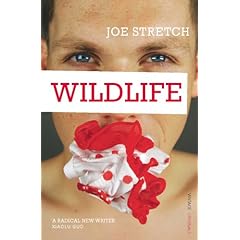
Wildlife, By Joe Stretch

"It's amazing what we can do with computers nowadays" is a mantra that cuts through Joe Stretch's second novel like a short circuit in a motherboard, endlessly sending the same signal. It's heartening to discover that the contemporary novel can still do amazing things, too. In his debut, Friction (2008), Stretch quickly announced himself as the sexy chronicler of the grotesque, yet in this second novel he takes a step back from the shock tactics of an eager debutant and delivers a serious meditation on technology and individualism. It is Ballardian in scope, and equally as exciting as his brutal debut.

Set in a world where "TV is dead", Wildlife follows four dispirited and lonely individuals looking for a way out of their boring "real" lives. Art school drop-out Anka is now a presenter for late-night "Quiz TV" on "Channel Manc". Janek, a session musician, has been "waiting his whole life for something to matter". Roger, a blogger, is literally metamorphosing into technology and Joe, morbidly fascinated with his ex-girlfriend's excrement, will do just about anything to get her back.
The online temptations of the -social network "Wild World" hang over this group like a blue sky of possibility. This new technology, a feeder of vainglorious egos, pulls these characters together. Wildlife explores the determined fervour and crippling pointlessness of their yearning for individualism. The idea that a true individual can never find peace with the self is given added gravitas when their worlds come crashing down around them. Except that, online, there is no one to pick up the pieces.

Wildlife succeeds in its assured surveillance of the myriad possibilities available, much more interesting than the characters' own lives, on a burgeoning technology. This dark and twisted exploration of ego reveals life as we would like it to be, uploaded for our pleasure. The novels of Joe Stretch, like Ballard's before him, transmit back to us our continuing inability to grasp hold of modernity.

[original source: The Independent, Tuesday, 28 April 2009]

*

Thursday, 21 January 2010

In Print(1) . . .


The Bird Room, By Chris Killen


No more than 26 pages into Chris Killen's debut novel, its narrator reconciles himself to the fact that things aren't going to get much better. "I don't want to be part of things any more," he laments. An impatient reader might acquiesce, mistaking this novel as yet another male-in-crisis fiction about unrequited love and loneliness. But those who seek something unique in the contemporary British novel will delight in this adroit, snappy debut, a dark and beguiling meditation on the weight of being, conveying the notion of the trapped individual riveted to an existence that makes no sense.


Yet The Bird Room is a novel so fresh it practically pings with energy. The bulk of this slim debut follows narrator Will, a bored twentysomething stuck in a job he hates, as his relationship with the smart and alluring Alice slides deeper into paranoiac turmoil. He becomes convinced that Alice is about to embark on an affair with his childhood friend, a minor artist also called Will. Mirroring this forlorn tale of niggling unease is the darker account of Helen, a wannabe actress who prefers to find work answering strangers' lewd propositions on internet "adult contact" sites.


The Bird Room is a novel of masks and shifting identities, used by each character to hide from an alien and mesmerising world. The most interesting of these masks, apart from Helen's somnambulistic veil, is possibly the artist Will's, as he floats from one exhibition to the next in the vainglorious hope that some kind of authenticity will be achieved. Will's art, his pursuits of the opposite sex, and the art world, are all meaningless. Yet there is also something undeniably real about him.


The fragmentary make-up of The Bird Room is seamlessly woven into a perfectly formed whole that fizzes with deadpan wit and cutting one-liners. Killen peppers the narration with modern technologies; whereas lesser writers using similar hooks might get carried away, Killen possesses enough savoir-faire to understand that a story still needs to be told. The Bird Room, a novel of misguided youth, is an exciting debut from a novelist already beginning to display maturity beyond his years.


[original source: The Independent, Thursday, 12 February 2009]

*

Blog Archive

Labels

2014 (1) 3:AM Magazine (1) 3AM Magazine (1) 4th Estate (1) aircraft (1) Amber (1) Andrew Gallix (2) Ann Quin (2) Art (1) Ben Myers (2) Book covers (1) Book Launch (2) Booker Prize (1) Bookforum (1) Boredom (1) Bram van Velde (1) Brighton (1) Broadway Books (1) Captain Beefheart (1) Carcanet Press (2) Central Station Design (1) Chris Killen (1) Competition (1) Dalkey Archive (4) Dante (1) Death (1) Dumitru Tsepeneag (1) Ellis Sharp (1) Events (1) Everyday Publishing (1) Evie Wyld (2) Gabriel Josipovici (5) Gavin James Bower (1) Georges Bataille (1) Gwendoline Riley (1) Hans Fallada (1) Harper Collins. (1) Hendrik Wittkopf (1) HP Tinker (1) Hubert Selby Jr (1) INS (1) Interviews (1) Jacques Roubaud (1) JD Salinger (1) Jean-Philippe Toussaint (4) JG Ballard (1) Jim Carroll (1) Joe Stretch (1) Jon McGregor (2) Jonathan Lethem (1) Karen Jackson (1) Kevin Cummins (1) Leda and the Swan (1) Light Boxes (1) List (2) Litro (1) LRB (1) Lydie Salvayre (2) Manchester United (1) Manifestos (1) Marion Boyars (1) Martin Heidegger (1) Melville House (11) Modernism (1) Myth (1) New Statesman (1) New Stuff (1) New York Times (1) Nick Cave (1) Noah Cicero (1) Not The Booker Prize (1) Novel (1) Olivier Pauvert (1) On Boredom (1) Pylons (2) Readings (2) Regent's Canal (2) Reviews/Criticism Archives (9) RIP (1) Samuel Beckett (3) Shane Jones (1) Sophie Lewis (1) Steve Finbow (2) Steve Mitchelmore (2) Stewart Home (1) Stuart Evers (1) Swans (1) Tao Lin (3) The Big Green Bookshop (1) The Canal (15) The Divine Comedy (1) The Failure Six (1) The Guardian (2) The Independent (6) The Quarterly Conversation (1) This Space (1) To Hell With Publishing (2) Tom McCarthy (3) Tony O'Neill (2) vapour trails (1) Vulgar Things (1) Yale University Press (1) Yeats (1) Zachary German (1)